Well, it’s been a while.
In my last post I whined a LOT about being in a slump. Little did I know at that time that it would last until after tax day! In the meantime, I learned about writing seasons. These seasons don’t have anything to do with the weather outside and everything to do with when a writer is productive and when they shut down. I’ve decided I was in my ‘winter season’, and it just happened to correspond with the weather outside.
In one of my early blogs I posted that when I first retired I took a bunch of classes before I really began writing. In fact, I didn’t start writing my book until April. Here’s what I said:
“Beginning in January of 2025, I started taking classes, buying software, exploring ideas and reading everything I could get my hands on about writing a novel. In April I started, and by August I had my first messy draft of my first novel, a cozy mystery titled Steeped in Gossip.“
See what it says there? “In April I started …”
So, here it is, April again, and I feel like I’ve come out of a period of intense rest, ready to hit the ground running and move forward on the next book in the Georgie series. Interesting, right?
So, I’ve put the stick away for good (at least in that respect.) No need to beat myself up if I’m taking a few months to regroup, give my mind a rest, and prepare for the next productive season. Just like last year, I’ve taken a bunch of classes, read a bunch of books, and am eager to start writing again, every day. Woohoo!
Okay, how about some more about my process? It’s messy, and this being only my second book, it’s also unfinished, but that’s okay. We all are.
At one point I talked about how I start out – idea, title, maybe the opening scene. Once I get those kind of set in my mind, I start outlining. I mentioned pantsers, plantsers, and planners, and said I think I’m a plantser, but really, except for the beginning of the book, I think I’m more of a planner. I like to have a plan and a schedule. It’s really difficult for me to just sit and write – I have to know where I’m going and when I can type “The End”.
So – outlining. I usually have a pretty good idea of the bare bones – who gets murdered, who does the murdering, where it happens. I also typically have the characters in my head – more about them later. What I don’t have are the actual details of that plot – all the little red herrings and hidden clues and chase scenes. That’s where the outline comes in, and this part gets a little messy, because, being who I am, I have to start at the beginning and go on until the end.
I usually start out using my magnetic white board and magnetic sticky notes (whoever invented those needs enough money to retire on, right now!) I don’t worry about anything except getting beats down. Beats are anything that moves the plot forward. They can be buried in a scene or the scene itself. They measure change. Here’s an example:
“Mason typed faster, pulling up screen after screen, scanning code as he went.”
That might feel like a beat, but it’s not. Nothing has happened. Mason is scanning code – big deal. Now let’s see what it looks like as a beat.
“Mason typed faster, pulling up screen after screen, scanning code as he went. Suddenly he froze.
“That’s not possible.”
“What?”
“Someone’s already been in the system.”
Now it’s a beat because something changed. A discovery was made.
Anyway, I’ve trained myself to think in terms of “beats” because that’s where I’m weak. I can describe something until the cows come home, but creating beats that move the story forward can be difficult.
So I sort of free-think. I know there’s a murder, I usually know how it’s committed, blah blah blah. Now I have to think of how to get from one beat to the next and string them together in a way that makes a story come alive and results in an interesting book. Not easy for me, but I’m getting better at it. I write all my ideas and thoughts down and throw them up on the whiteboard, then take a step back and try to put them into some kind of order. That helps me find holes where I need more, or places where I have umpteen things happening in a two-hour period and need to spread them out somehow. It’s a really fun exercise. Here’s a portion of my whiteboard for Overdue for Murder.
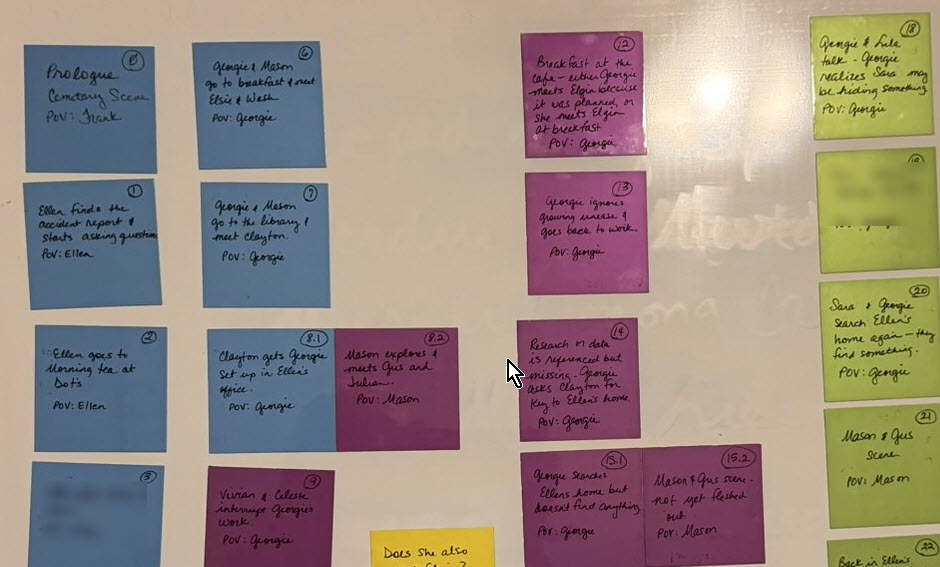
You can see that I number the events, and not all of them are beats. For example, #13 (in purple) simply says “Georgie ignores growing unease & goes back to work.” Not much happening there, right? Another one simply says “Mason & Gus Scene”. I knew I wanted something to happen with Mason and Gus, but not what, so that’s all I put. The rest will come later (I hope!).
(Notice I blurred out some of my notes. No spoiler alerts here!!)
Anyway, these help me put my story in order and become the backbone from which I build my outline, which fleshes out the scenes in more detail.
That’s enough for today, I think. I’m sure you’re getting tired of me.
What would you like to hear about next time? Characters? What the final outline looks like? What happens when I get to writing and head off into regions not covered in the outline? I’m open to whatever you want to know!
Thanks for hanging with me. Happy reading!